← Back
Product Proposal

Transforming Facemoji Keyboard into an AI Agent

From emoji keyboard to AI copilot — one tap away, inside every app.

Context
Facemoji is a top expression keyboard exploring the next evolution of AI experiences.
Goal
Rethink the keyboard as an AI Agent that helps users accomplish real tasks across apps.
Role
Product Strategy & Vision
550M+
Global Downloads
170+
Countries & Regions
#9
a16z Top 50 GenAI Apps
01
Context

Facemoji already owns the expression layer of messaging

Facemoji is one of the largest expression-first keyboards globally. With 550M+ downloads across 170+ countries, it is not starting from zero — it already sits at the center of how people communicate visually.

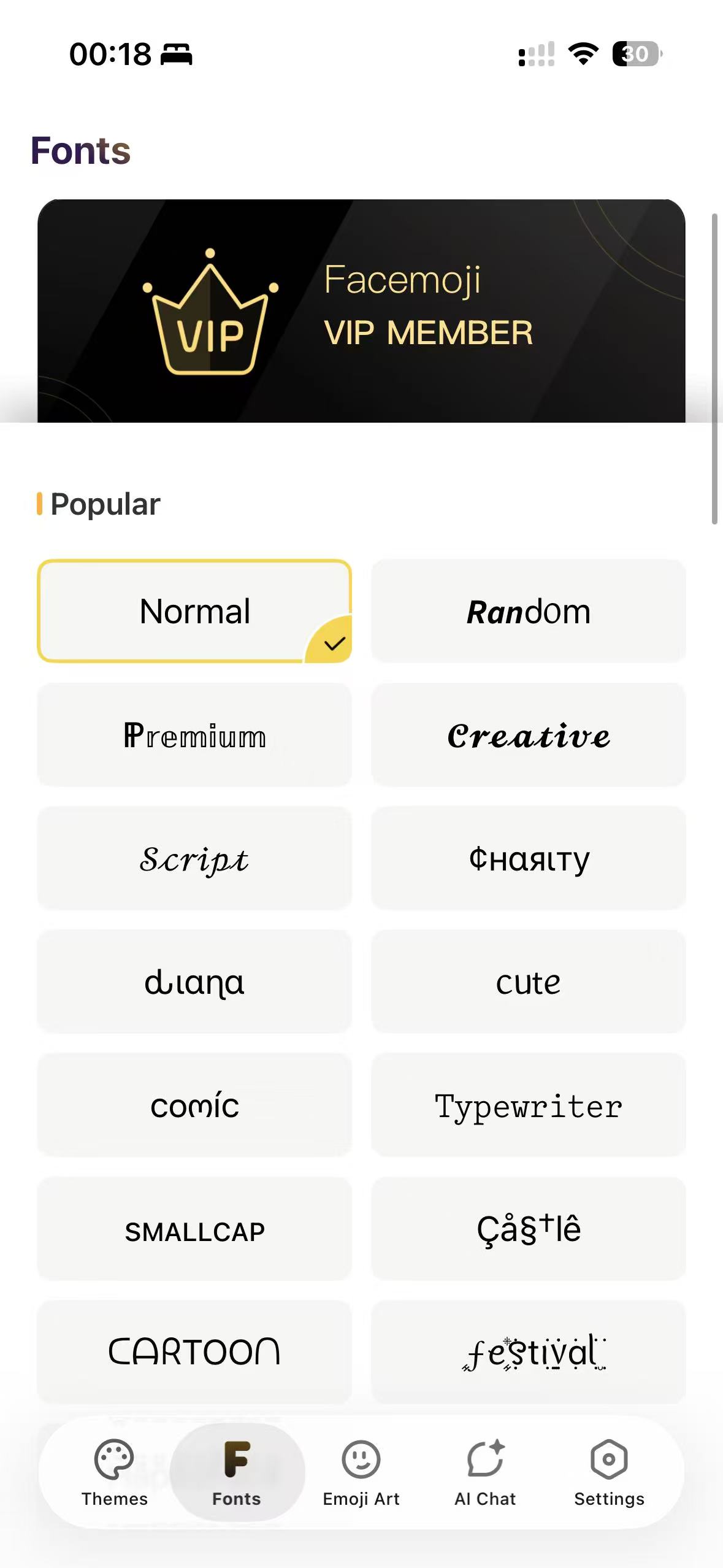
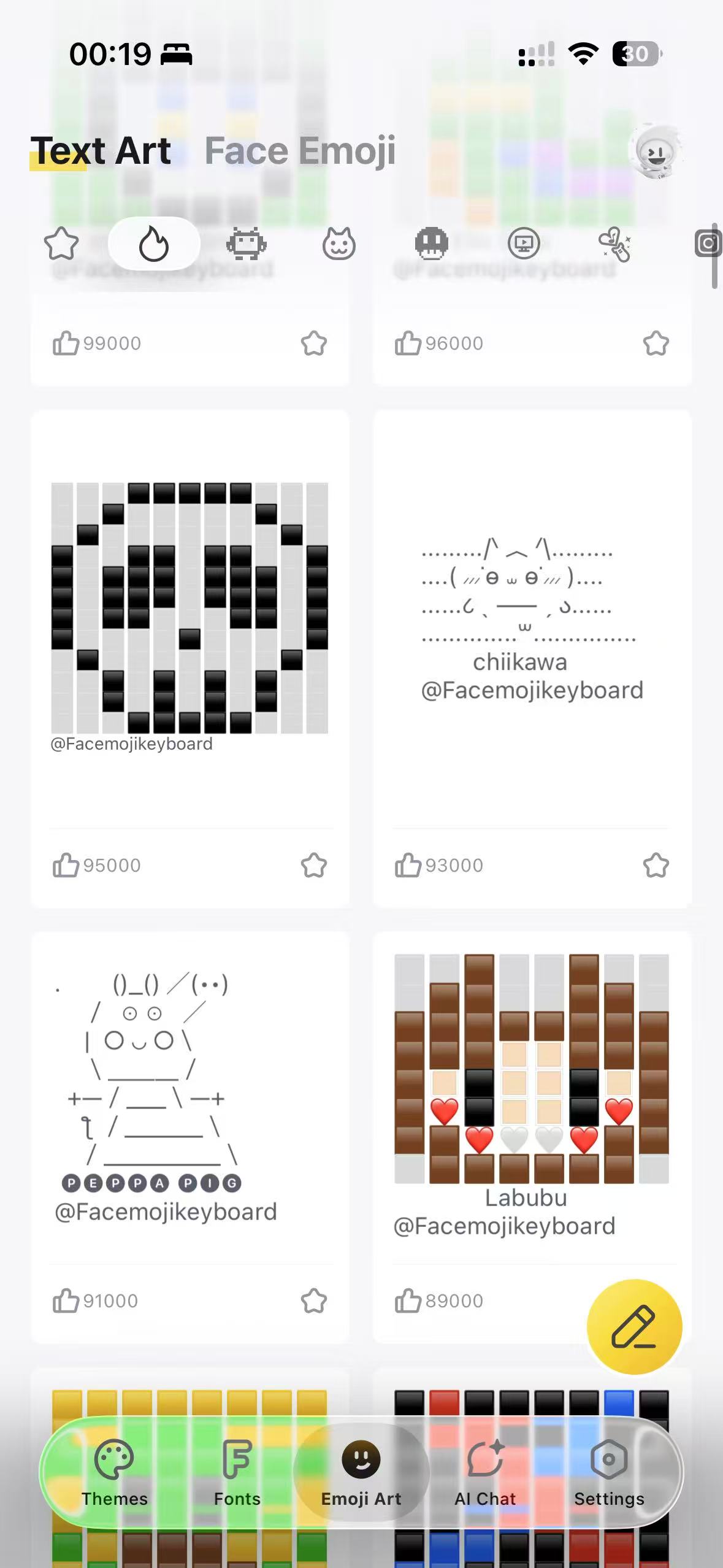
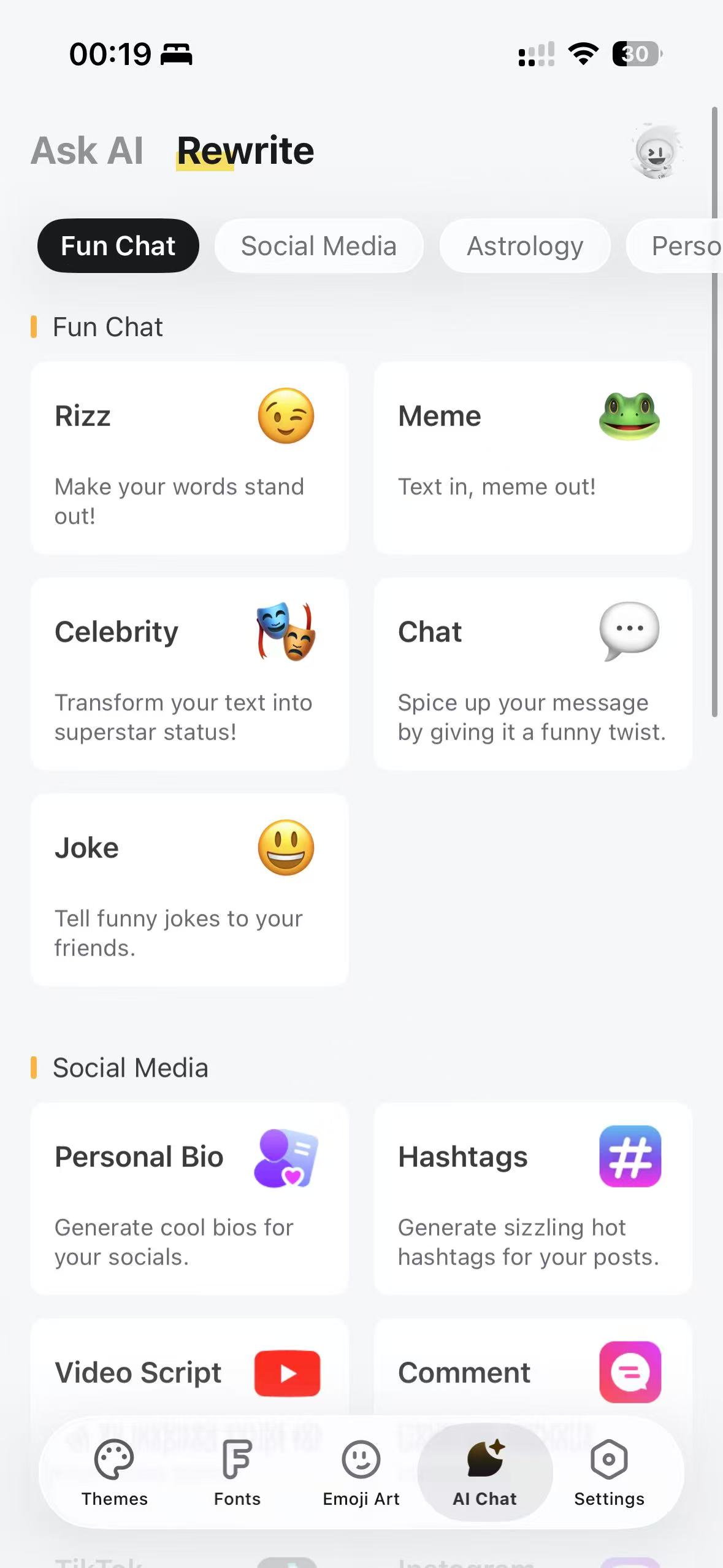
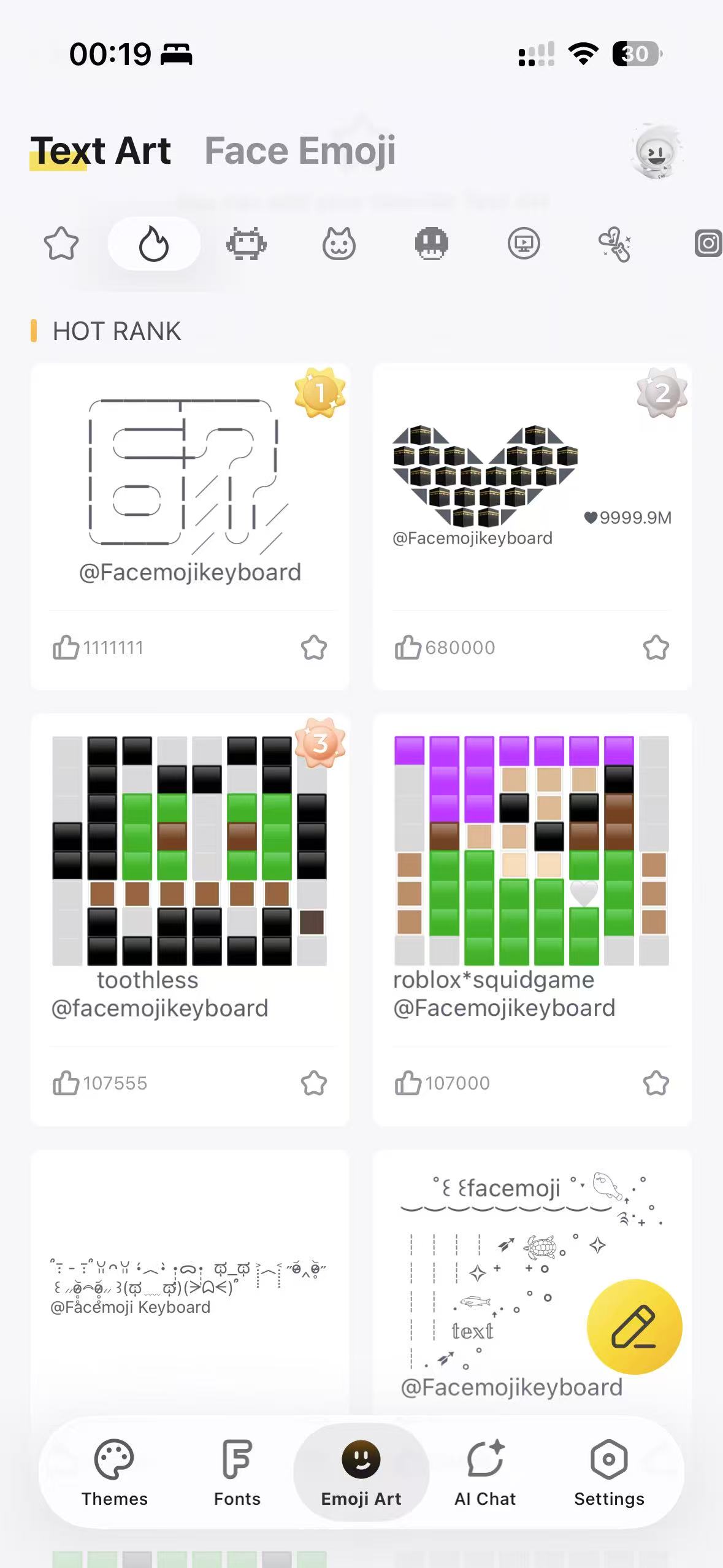
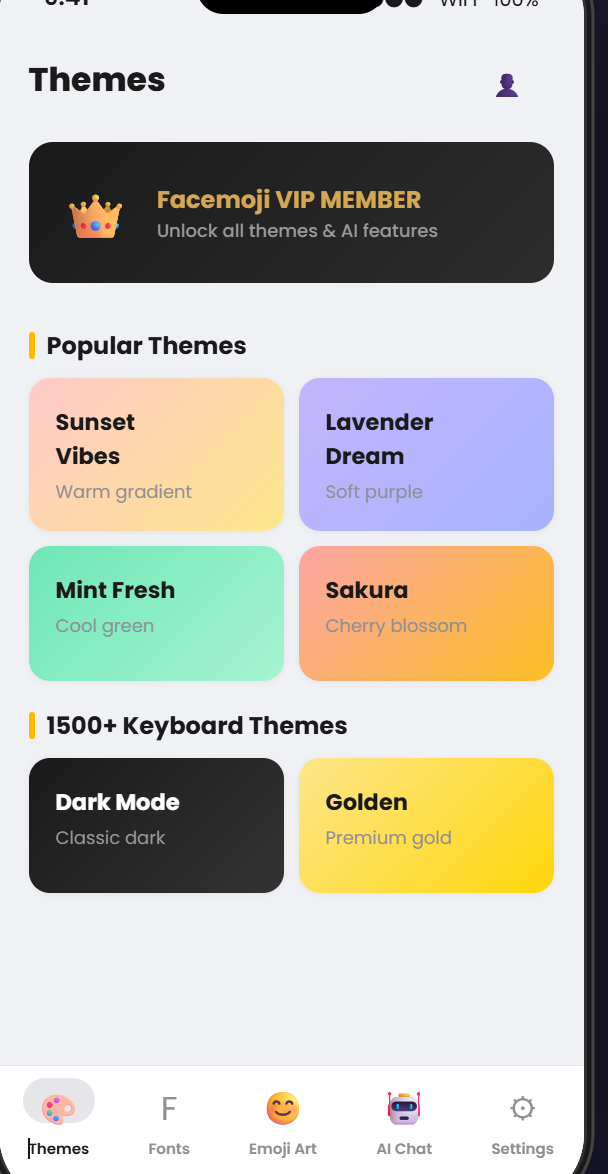
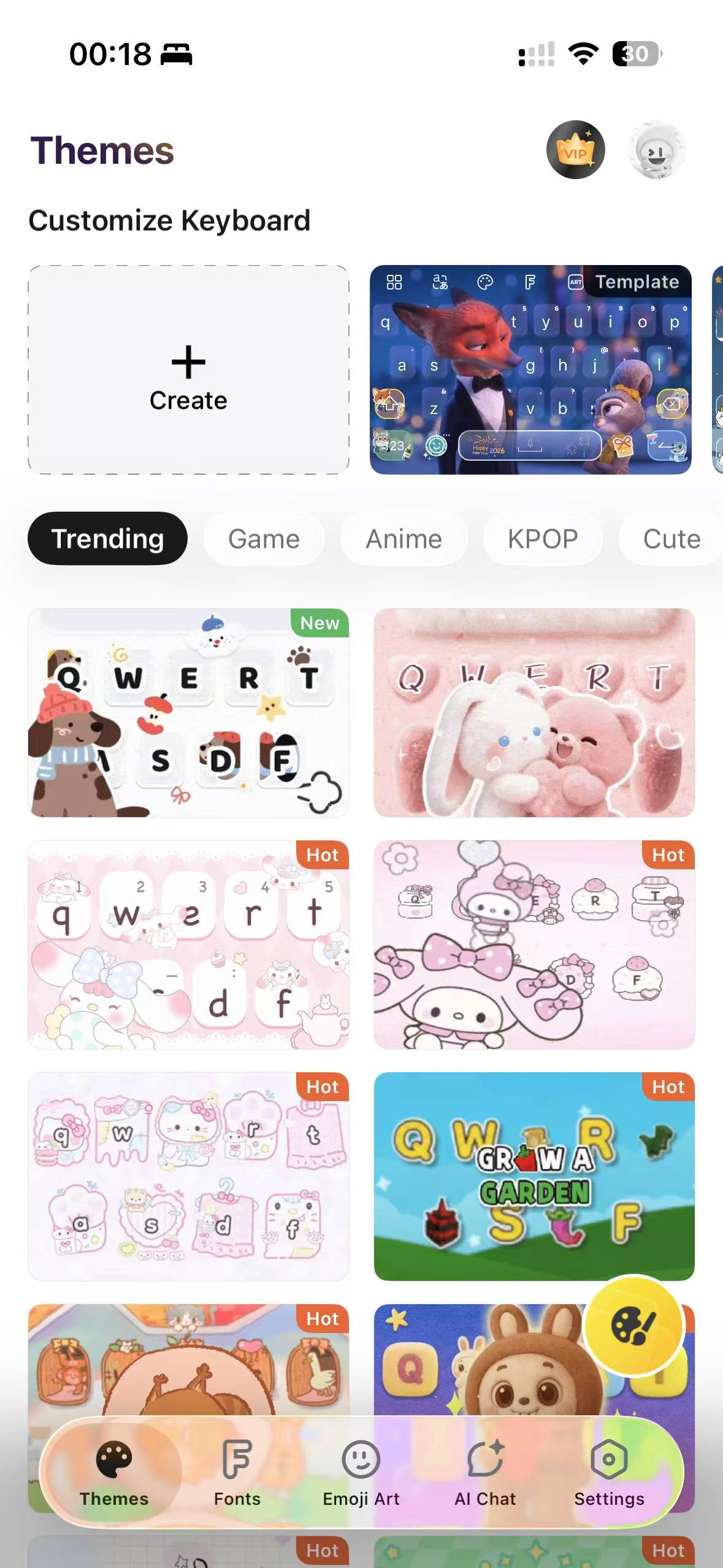
6,000+ emojis Stickers & GIFs 1,500+ themes 200+ text styles AI writing & translation

Ranked #9 in Andreessen Horowitz's Top 50 GenAI Mobile Apps (2024).

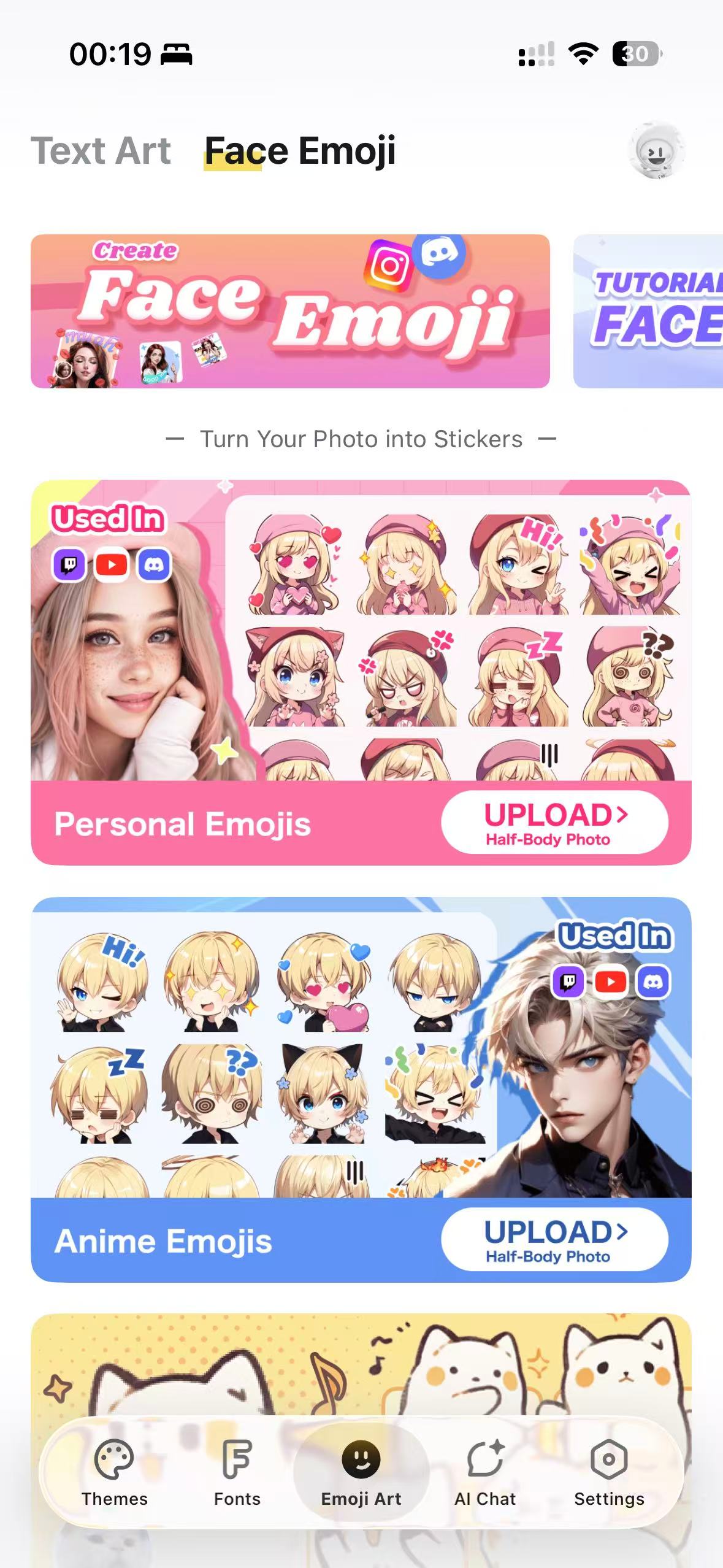
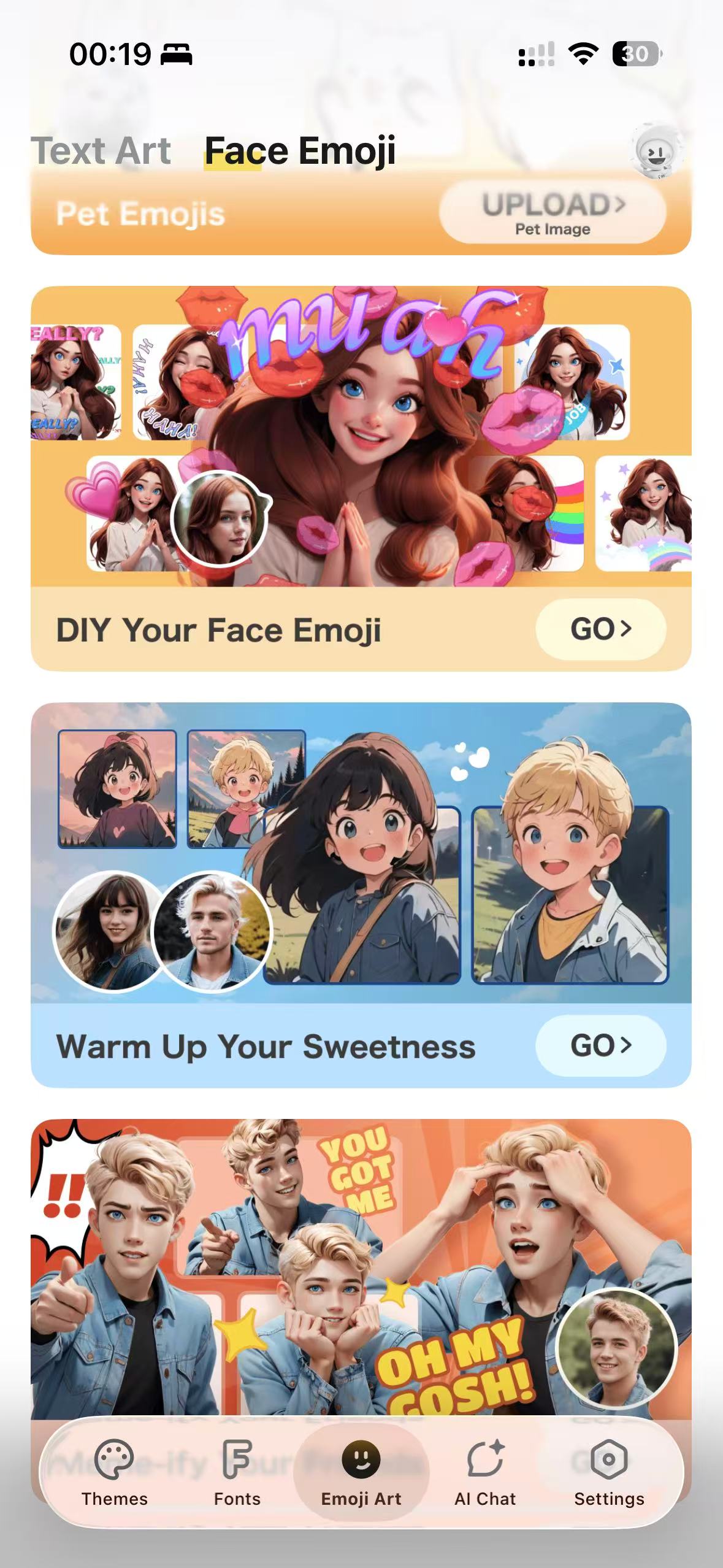
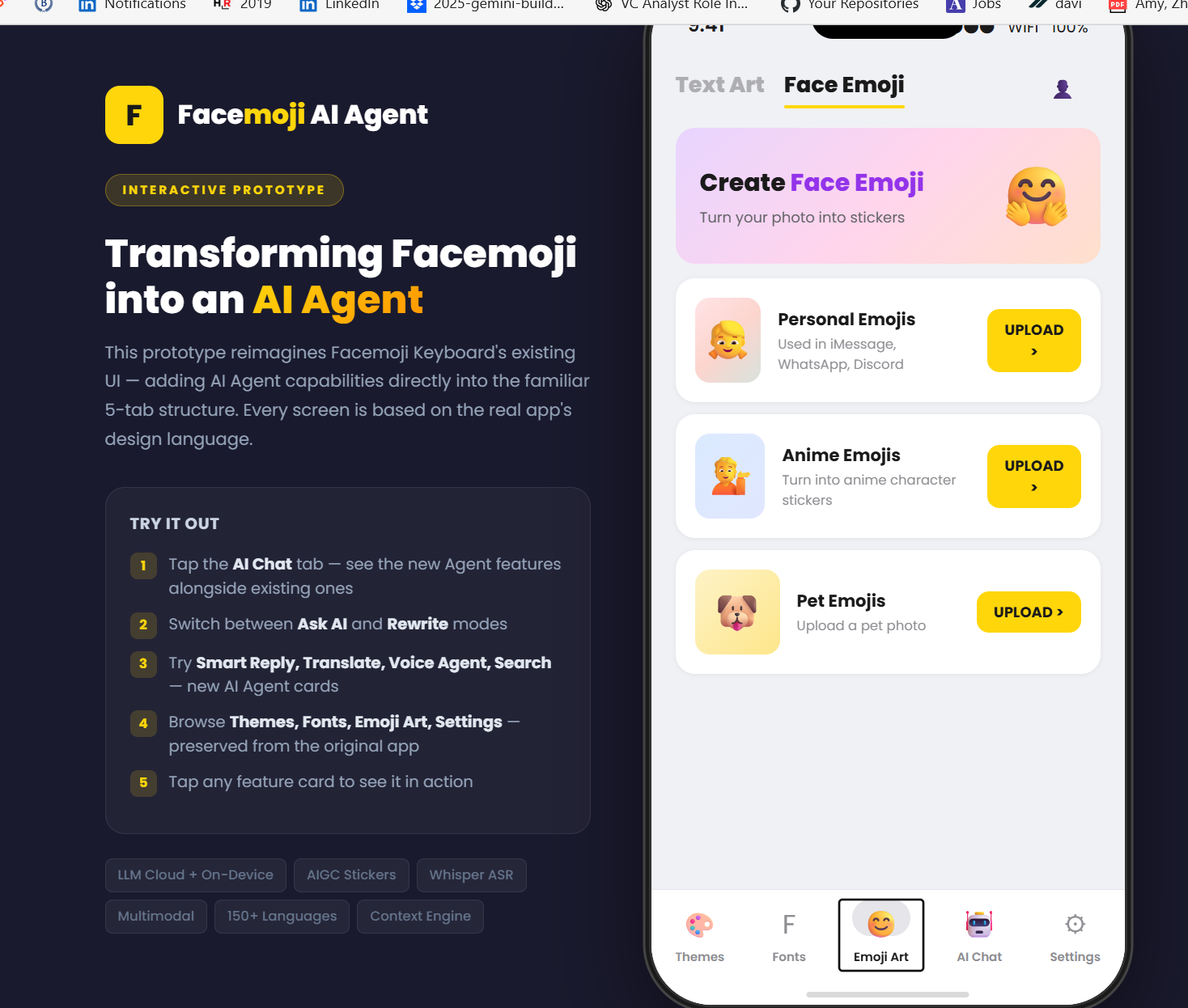
Facemoji Face Emoji features
02
Behavior Shift

Communication has become expressive, but responding is still manual

Digital communication has shifted from text-only to visual, emotionally rich interaction. Modern messaging includes emojis, stickers, GIFs, memes, and visual reactions. Yet responding still follows the same loop.

10B+
Emojis sent daily
92%
Internet users use emojis
91%
Say emoji help express themselves
69%
Prefer emoji over text for emotions

Gen Z uses emojis in 57% of online communications. 88% of Gen Z workers say emoji are helpful even in workplace messaging. The shift isn't just cultural — it's structural.

📌 TL;DR — Predictive keyboards improve typing speed. They do not reduce the effort of deciding how to respond.
03
User Feedback

I analyzed hundreds of user reviews to identify what users actually want

What users love

  • Expressive emojis, stickers, and GIFs
  • Playful themes and fonts
  • Personalization and aesthetic identity
Facemoji stickers

Where users struggle

⚠️

Reliability

Keyboard glitches, disappearing, lost themes and saved keyboards

🔓

Control

AI features feel intrusive, settings hard to manage, can't turn features off

⌨️

Typing Quality

Weak autocorrect, inaccurate swipe typing, poor voice typing

💰

Monetization Friction

Too many ads disrupting flow, premium features locked behind paywall

📌 TL;DR — Users don't want "more AI." They want expressive communication without friction.

Primary ICP: Gen Z expressive communicators

Proxy demographic data from emoji-heavy app usage. 79% of users are under 35. This audience is active on TikTok, Instagram, Snapchat, Discord, and WhatsApp — platforms where expression-first messaging is the default.

Gen Z spends ~3.5 hours/day across social platforms. 49% use TikTok for product discovery. 41% turn to social media first for information — ahead of search engines (32%).

18–24
51%
51.3%
25–34
28%
28.3%
35–44
12%
12.1%
45+
9%
8.3%
04
Competitive Landscape

Current keyboards solve typing or writing — not expressive response decisions

The keyboard market splits into three categories. None address the gap between expression and intelligence. The virtual keyboard market is valued at $1.1B (2022), projected to reach $2B by 2032.

System Keyboards

Gboard, SwiftKey

Typing infrastructure, emoji search, translation. Gboard has 10B+ downloads via pre-installation. SwiftKey leads North America through Microsoft ecosystem integration.

Expression Keyboards

Facemoji, Kika, Bobble, FancyKey

Emojis, stickers, themes, fonts, visual identity. Rich creative tools but limited AI intelligence. Growth via personalization novelty.

AI Writing Keyboards

Grammarly, CleverType

Grammar correction, rewrite, tone change. Grammarly has 40M DAU, $700M revenue. Powerful generation but no expression layer.

Competitive Positioning Map
Typing Infrastructure → Expressive Communication No AI → AI-Powered AI + Typing AI + Expression Basic Typing Basic Expression Gboard SwiftKey Gram-marly Clever-Type Kika Fancy-Key GO Bobble Facemoji AI ✱

No keyboard today owns AI-powered expressive communication — helping users decide how to react, respond, and express the right tone.

05
Market Insight

The market optimized for novelty, but users want communication outcomes

Successful players implicitly understand users want quick emotional expression, personalization, multilingual support, and fast daily texting. But the category is built on three fragile assumptions:

01
"Customization drives retention"
→ Users switch back to native keyboards when performance drops or the experience becomes intrusive.

Source: Facemoji app store reviews consistently cite reliability as the #1 reason for uninstalling. Gboard retains users primarily through pre-installation and performance, not customization.

02
"Ads can sustain the free model"
→ Excessive ad load creates direct friction in a high-frequency product.

Source: "Too many ads" is the most common 1-star complaint across expression keyboards (Facemoji, Kika, GO Keyboard) on Google Play. Grammarly's ad-free freemium model drove $700M revenue — proving friction-free UX converts better.

03
"Emoji novelty drives long-term growth"
→ Users increasingly care about faster communication decisions, not more emoji packs.

Source: Gen Z uses emoji in 57% of communications (Emojipedia 2025), but engagement with new emoji packs has plateaued. Meanwhile, AI writing tools (Grammarly, ChatGPT) are the fastest-growing keyboard-adjacent category.

📌 Opportunity — Build AI that helps users react instantly, respond quickly, express tone naturally, and communicate across languages — without interrupting typing.
06
Product Vision

Facemoji becomes the AI Copilot for expressive communication

React

Context-aware emoji suggestions, GIFs, stickers, and meme-style replies based on conversation tone

💬

Reply

Smart replies, message summaries, tone rewrite, and real-time translation across 150+ languages

✍️

Create

Captions, hashtags, meme text, text-art, and AI-generated sticker/emoji packs

🎯

Act

Search, planning, recommendations, and next-step prompts — all inside the chat

🎤

Voice AI

Voice-to-text with tone detection, voice-triggered AI commands, and speech-to-emoji conversion

🧰

Social Twin

AI learns your personal style, slang, emoji patterns, and tone — generating replies that sound like you

📌 Principle — Not a separate chat app. Not an intrusive toolbar. Not a Grammarly clone. AI should be assistive, optional, fast, and native to the keyboard.
How it works in practice
Celebrating
I just got promoted!! 🎉🎉
AI suggests:
🎉🎉🎉LETS GOOO 🔥drinks tonight??
Making plans
Want sushi tonight? 🍣
AI suggests:
Yes!! 🍣🕔 7pm?Find sushi nearby
Multilingual
¿Oye quieres ir al cine esta noche?
🌐 "Want to go to the movies?"
¡Sí, vamos!¿A qué hora?
07
Value, Monetization & U.S. Growth

Facemoji AI creates user value, unlocks monetization, and supports U.S. growth

7A. User Value

The clearest unmet need from reviews: faster expressive communication with less friction. Facemoji AI reduces the cognitive load of "what do I say next?"

7B. Monetization Playbook

Three revenue paths, each validated by comparable products:

A. Freemium AI Subscription

Keyboard-native AI is a proven paid model. Users pay when AI saves time in their most frequent daily activity.

Grammarly: 40M DAU, ~$700M rev CleverType: $4.99/mo iOS $13B+ valuation

Free core keyboard + paid AI power features (smart reply, meme generation, translation). Grammarly's keyboard-to-desktop funnel converts at $12/mo.

B. Creator Marketplace

User-generated expression content as a self-sustaining revenue engine. LINE proved this at massive scale.

LINE: $75M sticker sales (Yr 1) 390K → 4M creators Top creators: $1M+

LINE takes 50% revenue share. Flywheel: more creators → more stickers → more purchases. Facemoji replicates with AI-generated stickers, emoji packs, themes.

C. AI Content Generation Upsell

Premium AI tools (meme generators, avatar creation, caption tools, AI sticker packs) deliver direct social utility — natural paid upgrades. Users pay for tools that make their messages more interesting.

7C. U.S. GTM Playbook

A strong U.S. GTM should focus on where Gen Z already communicates, discovers products, and expresses identity. The playbook combines channel strategy, viral mechanics, and phased rollout.

Primary channels

🎥

TikTok

~6 in 10 US teens use daily

89 min/day

49% use for product discovery

📸

Instagram

58% of Gen Z use daily

52.4M

Gen Z users in the U.S.

👻

Snapchat

55% of US teens, 68% weekly

453M DAU

Global daily active users

Comparable GTM case studies

Bitmoji × Snapchat

Snap acquired Bitmoji in 2016 for ~$100M. Deep keyboard + chat integration made Bitmoji the #1 iOS app in 2017. Bitmoji proved that personalized expression tools, when embedded in messaging, create powerful distribution loops.

#1 iOS App (2017) 150M → 453M DAU

Lesson: Embed expression tools where people already message. The keyboard is the distribution channel.

Duolingo's Social Strategy

Duolingo grew from 37M to 116.7M MAU partly through an "unhinged" TikTok strategy led by a single hire. Their content-first approach generated 17M TikTok followers and was named Ad Age Social Marketer of the Year.

37M → 116.7M MAU 17M TikTok followers 11% engagement rate

Lesson: Brand personality on TikTok can be a primary growth engine, not just awareness. Facemoji's expressive outputs (meme replies, AI stickers) are inherently shareable content.

Phased rollout

Phase 1 — Seed (Month 1–3)
Launch AI-native shareable use cases
Meme reply generator, "rizz" tone-based reply generation, AI caption tool for TikTok/IG. Ship as free features to maximize installs. Seed content on TikTok with 10–20 micro-influencer partnerships demonstrating outputs.
Phase 2 — Grow (Month 3–6)
Build the viral loop
Launch AI sticker/Genmoji-like creation. Every shared sticker, caption, or meme reply becomes marketing. Add watermark/branding on generated content. Introduce creator tools for power users to publish custom packs.
Phase 3 — Monetize (Month 6–12)
Activate paid features & creator marketplace
Launch Facemoji Pro subscription (advanced AI, unlimited generation, premium sticker packs). Open creator marketplace with revenue share. Introduce AI content upsells (avatar tools, premium meme templates, custom theme generation).

Viral mechanics

The core insight: in an expression keyboard, the output itself is the marketing. Every meme reply shared in a group chat, every AI caption posted to Instagram, every custom sticker sent on WhatsApp carries implicit distribution.

📌 Growth loop — Better messages → more sharing → more installs → more creators → more paid content → stronger retention.
08
Technical Architecture

Facemoji AI can be implemented as a lightweight multi-agent system

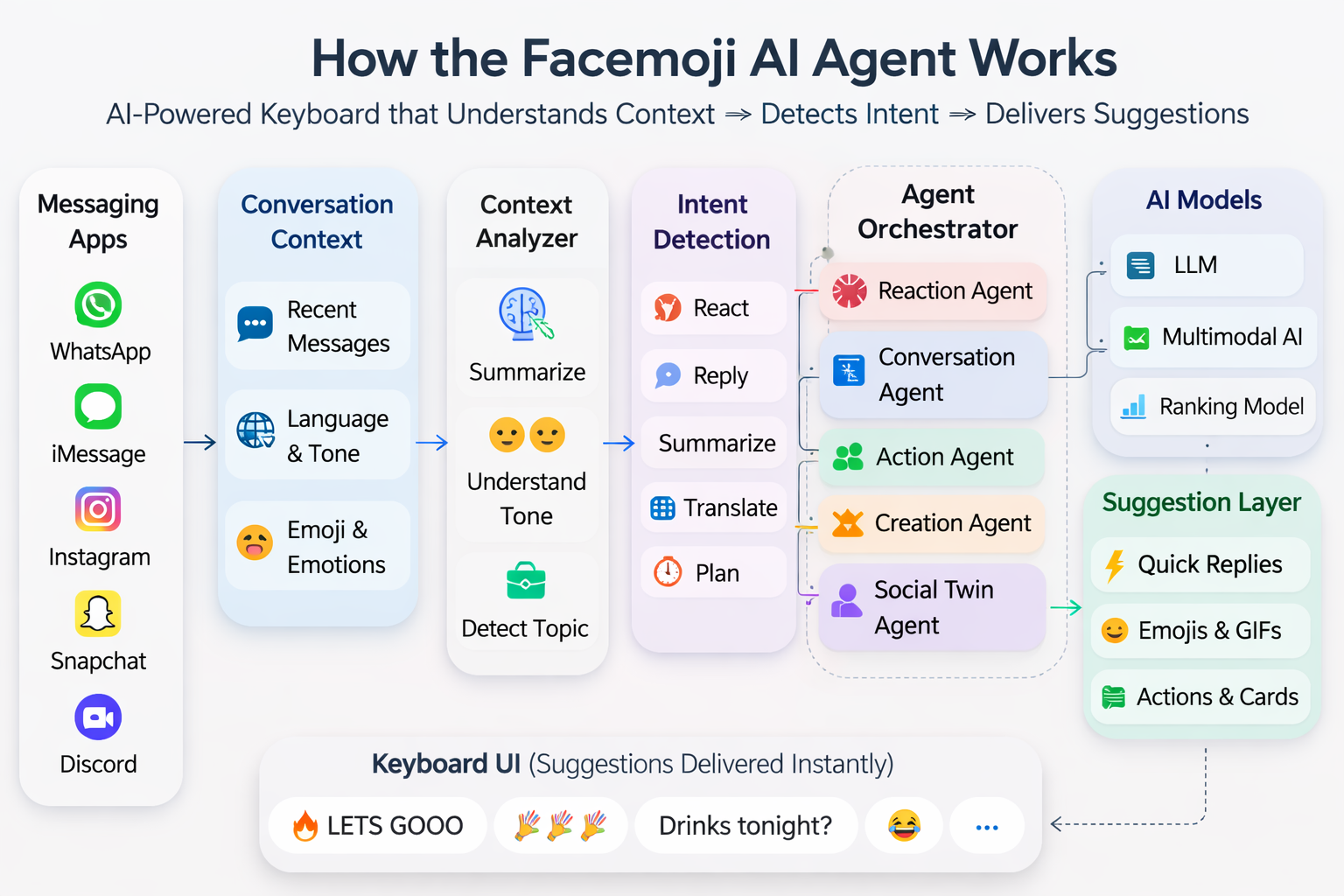
Facemoji AI Agent Technical Architecture

The diagram above shows the full pipeline from messaging apps to keyboard UI. Here's how each layer works:

  1. 01
    Conversation Context — Captures recent messages, detects language & tone, reads emoji & emotional signals from messaging apps (WhatsApp, iMessage, Instagram, Snapchat, Discord)
  2. 02
    Context Analyzer — Understands tone, detects topic, and builds a real-time snapshot of the conversation to inform downstream decisions
  3. 03
    Intent Detection — Classifies user intent: summarize, reply, translate, or plan — routing each to the appropriate agent
  4. 04
    Agent Orchestrator — Routes to specialized agents: Reaction Agent (emoji/GIF/meme), Conversation Agent (smart reply/rewrite), Action Agent (search/plan), Creation Agent (captions/stickers), and Social Twin Agent (personalized style mirroring)
  5. 05
    AI Models — LLM for text generation & summarization; Multimodal AI for images, stickers, and avatars; Ranking Model for fast suggestion ordering; Voice stack for speech-to-text and voice commands
  6. 06
    Suggestion Layer & Keyboard UI — Surfaces outputs as quick replies, emojis & GIFs, and action cards — delivered instantly inside the keyboard interface. On-device for latency-sensitive ranking; cloud for heavy generation.
📌 Design rule — AI must remain fast, optional, and non-intrusive to preserve the core keyboard experience.